CHAIN PICKEREL
Esox niger
- Name and Family
- History
- Distribution
- Impacts
- Identification
- Potential Lookalikes
- Biology
- Life Cycle
- Pathways of Spread
- Prevention
- Acknowledgements
- Image Gallery
Introduction
The chain pickerel (Esox niger) is an invasive freshwater fish species that can cause significant ecological harm to aquatic ecosystems. As an aggressive apex predator, it rapidly alters aquatic communities through the intense predation and displacement of native fish, depleting local food webs and prey populations.
Name and Family
Chain pickerel, Esox niger, is a freshwater fish belonging to the Esocidae family, otherwise known as the pike family. Common names include pike, pickerel, jack, jackfish, Southern pike, Eastern pickerel, grass pike, gunny and water wolf.
History
Chain pickerel are native to the eastern United States and parts of southeastern Canada, including regions of Québec. It is not native to Atlantic Canada, where all existing populations result from human‑mediated introductions. Chain pickerel was illegally introduced as a sportfish to Nova Scotia in the 1940s. Since then, further illegal introductions coupled with natural migration has resulted in an expansion of their distribution throughout Nova Scotia and New Brunswick. Chain pickerel are not yet known to be present in Prince Edward Island, however, the Department of Fisheries and Oceans Canada have listed the species as a moderate invasion risk for PEI’s freshwater ecoregions.
Identification
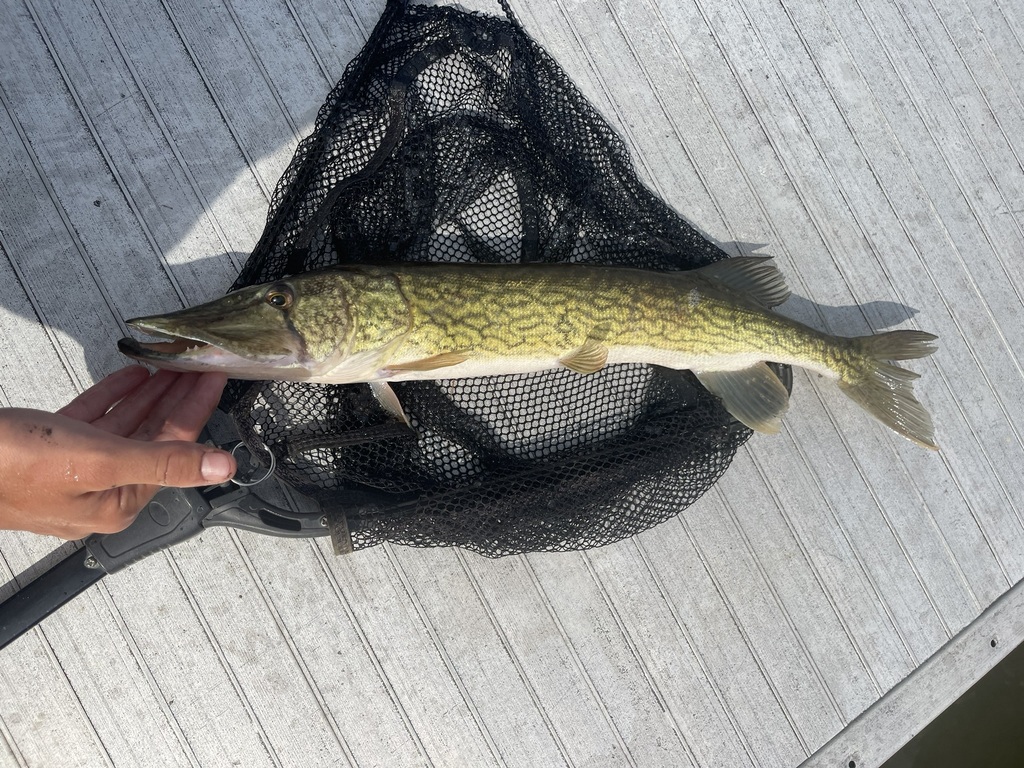
- 15-24 inches in length
- Torpedo shaped body
- Light and dark green chainlink pattern on sides (juveniles lack this pattern)
- Olive/green in colour
- Dark coloured back
- White underbelly
- Small sharp teeth
- Deeply forked caudal fin
- Black bar extending towards from eye
- Fins are unmarked (no pattern)
- 1-3 lbs in weight on average
Potential Lookalikes
While chain pickerel bears no resemblance to any freshwater fish native to Prince Edward Island, it is commonly mistaken as Northern pike (Esox lucius) and Muskellunge (Esox masquinongy) in Nova Scotia and New Brunswick.
Northern pike is another invasive sportfish in Atlantic Canada, known for eliminating populations of native game fish like brook trout and white perch. This species shares physical similarities with chain pickerel, and are capable of interbreeding. Northern pike is not present in Prince Edward Island, and should be reported if spotted. It can be distinguished from Chain pickerel by the following characteristics:
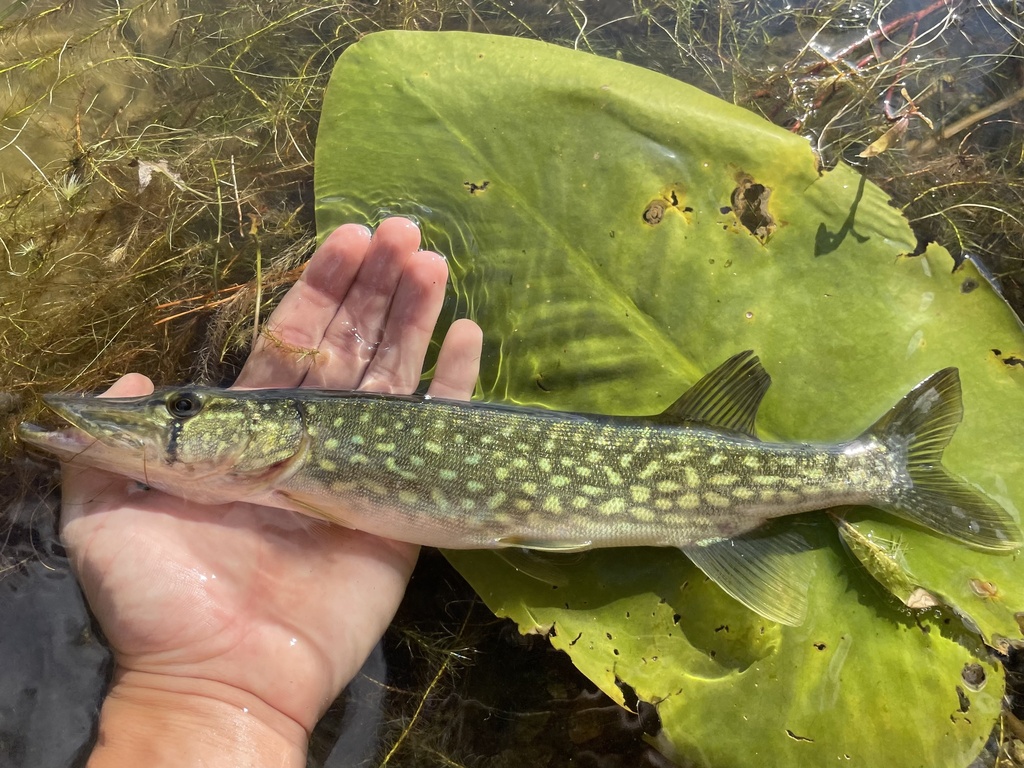
- Side Pattern: Northern pike have light-yellow or cream bean-shaped spots against a dark background, whereas chain pickerel feature a dark, chain-linked network over a yellowish-green body.
- Eye Marking: Chain pickerel feature a distinct dark vertical teardrop stripe beneath each eye, which northern pike lack.
- Fin Markings: The dorsal, caudal, and anal fins of the northern pike have dark spots or wavy patterns, while the fins of the chain pickerel are plain and unmarked.
- Adult Size: Northern pike grow significantly larger and heavier than chain pickerel (commonly reaching 60–100+ cm compared to the pickerel’s typical 38–60 cm).
- Cheek & Gill Scales: Chain pickerel have fully scaled cheeks and operculum (gill covers), whereas northern pike only have scales on the upper half of their operculum.
Muskellunge (also known as “muskie”) is a predatory fish that is native to the Saint John River system in New Brunswick, and to parts of the Great Lakes–St. Lawrence region. It is considered to be the largest fish in the pike family. While both fish share similarities, mature muskellunge are much larger than mature chain pickerel. While this species is not listed as invasive, it is not native to Prince Edward Island and should be reported if you believe you have seen it.The species can be distinguished from one another by the following characteristics:
- Side Pattern: Muskellunge feature vertical dark bars or spots along their sides, unlike the distinctive chain-link network of the chain pickerel.
- Eye Marking: Muskellunge lack a suborbital mark, whereas chain pickerel have a prominent dark vertical “teardrop” stripe extending downward beneath each eye.
- Cheek & Gill Scale Coverage: Muskellunge have only partially scaled cheeks and operculums (usually scaling on the upper half only), whereas the cheek and operculum of a chain pickerel are fully scaled.
- Fin Markings: The dorsal, anal, and caudal fins of a muskellunge typically feature dark spots or blotches, while those of a chain pickerel are clear and unmarked.
- Adult Size: Muskellunge grow dramatically larger, typically reaching 70–120+ cm in length, compared to the smaller adult chain pickerel (38–60 cm).
Impacts
Environmental Impacts
Chain pickerel are voracious predators in freshwater environments.Their feeding habits often lead to the displacement and predation of soft-bodied fish, such as the native brook trout (otherwise known as speckled trout). The absence of native fish and overall lack of biodiversity impacts the entire food web, affecting species of birds, otters, and mink, by depleting a portion of their food bank.
Economic and Social Impacts
Prince Edward Island is widely recognized as having world class brook trout fishing. The angling community, as well as the provincial and federal government, would be greatly affected by a chain pickerel invasion. Less individuals will travel to the island for angling opportunities if the brook trout populations dwindled due to the invasion of chain pickerel. To add, monitoring and management of the invasive species is very expensive, which can put financial strain on environmental non-profits and governing bodies.
Biology
Chain pickerel are successful predators in freshwater environments. Generally, Chain pickerel will consume small fish while young, and begin hunting large prey when they grow bigger. Their teeth are angled inwards, a design that helps them capture and hold on to prey. They feed on fish, amphibians, reptiles and small mammals. Chain pickerel are considered ambush predators. They remain very still in a hiding place, or resembling a drifting log, and ambush prey with their sudden surge of speed. They are extremely aggressive fish, known to hunt prey similar to their own size.
Their ideal habitat includes, but is not limited to: vegetated streams, lakes, swamps and rivers. They prefer bodies of water that have lots of vegetation/logs because it is tailored to their specific hunting style. This species is resilient, and can tolerate a wide array of harsh conditions. For example, Chain pickerel can handle warmer temperatures than our native Brook trout and Atlantic salmon. Furthermore, they are capable of surviving in brackish environments.
Life Cycle
The average life span of a chain pickerel is about 4 years, with a maximum life expectancy of about 8 years. They reach sexual maturity between one and four years. Spawning occurs in the spring between the months of March and April, when stream banks are flooded.. An adult female will lay up to 50,000 eggs in a vegetated area, where they are externally fertilized by one or two males. Once fertilization is complete, the adults abandon the eggs in the vegetation, where they stick to plants and remain there to incubate until they hatch. Chain pickerel eggs hatch 6 to 12 days after fertilization. Fry (juvenile fish) are born in yolk sacs, which they absorb over the course of a week before they begin actively hunting prey.
Prevention
Chain pickerel are almost impossible to remove from a waterbody. The greatest tool is prevention!
Never release sportfish, pets, or live bait into water bodies from which they did not originate. It is illegal, and can facilitate the introduction of harmful invasive species or diseases. If you are looking to ethically surrender a pet that you can no longer care for, please contact the PEI Humane Society to set up an appointment. If you are unable to ethically surrender your pet at the humane society, other places you may check out include: nursing homes, schools, vet clinics, daycares, pet stores and Facebook groups.
Properly dispose of unused bait in a garbage bin on land.
Acknowledgements
This webpage was developed with the financial support of the Department of Fisheries and Oceans Canada through the Aquatic Invasive Species Prevention Fund.
Image Gallery