GOLDFISH
Carassius auratus
- Name and Family
- History
- Distribution
- Impacts
- Identification
- Potential Lookalikes
- Biology and Life Cycle
- Pathways of Spread
- Prevention
- Acknowledgements
- Image Gallery
Name and Family
Goldfish, Carassius auratus, is a member of the carp and relatives (Cyprinidae) family. This family is also collectively called “cyprinids”.
History
- Goldfish are native to eastern Asia and were introduced to North America through the ornamental fish trade and the commercial baitfish industry. Fish were released into the natural environment as early as the 1600s. By the 19th century, they became established in waters around New York and Boston.
- They are considered one of the most widespread invasive fish in North America and one of the most available fish in the aquaculture industry.
- Goldfish have been reported throughout all Canadian provinces.
Distribution
On PEI, goldfish have been found in Hardy Mill Pond, Kelly’s Pond, and Deadman’s Pond.
Impacts
Environmental Impacts
- Goldfish have extremely high reproductive rates, laying thousands of eggs at once, which allows them to quickly colonize an area. Large populations can outcompete native fish.
- Goldfish affect water quality of natural waterways as their feeding behavior increases turbidity because they stir up the sediment. This reduces the amount of sunlight that reaches submerged aquatic plants, which can lead to mass die-off of native vegetation, a crucial habitat and food source for native fish species. Their foraging habit can also uproot vegetation.
- Goldfish eat snails, small insects, fish eggs, and young fish, competing with native fish for food.
- The presence of goldfish has been linked to increased risks of algal blooms as they re-suspend nutrients and make them available to phytoplankton. In addition, the growth of cyanobacteria can be stimulated by passing through goldfish intestines.
- Goldfish feed on the eggs and larvae of native fish species, such as brook trout.
- Goldfish harbor diseases and parasites, such as Cyprinid Herpesvirus 3, that can spread and kill wild fish populations.
Economic and Social Impacts
- Goldfish can disrupt sport fishing and fishery operations as their high population numbers can outcompete commercially important fish species.
- It can be extremely costly to remove goldfish from the environment and subsequent restoration efforts are expensive.
Identification
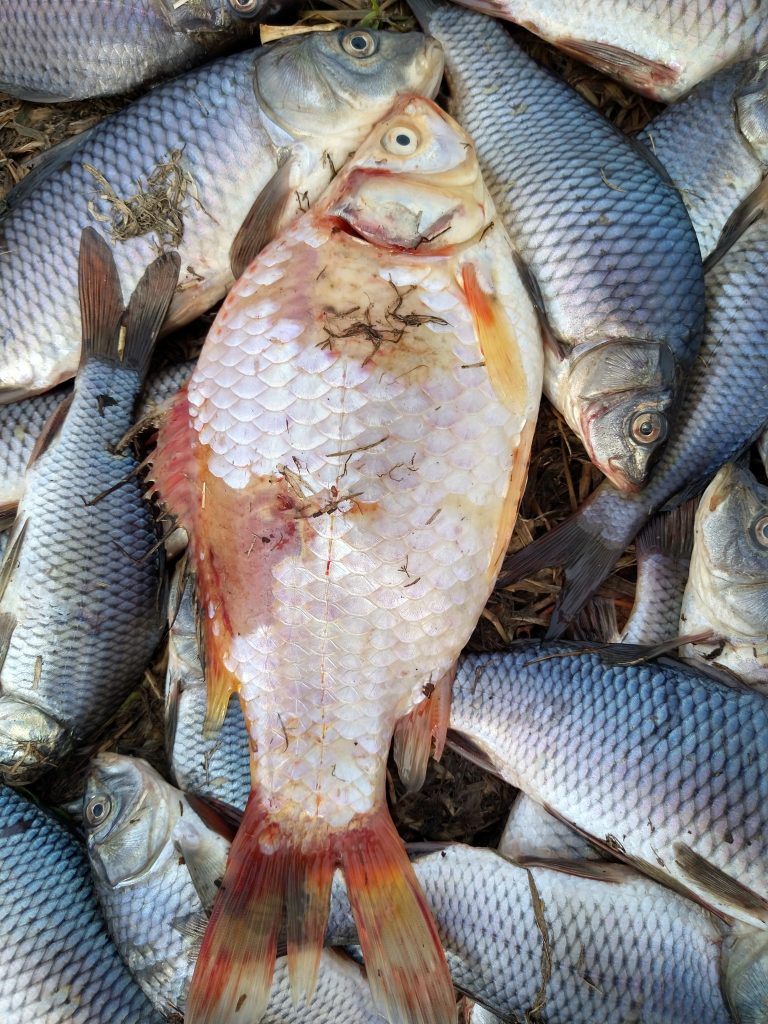
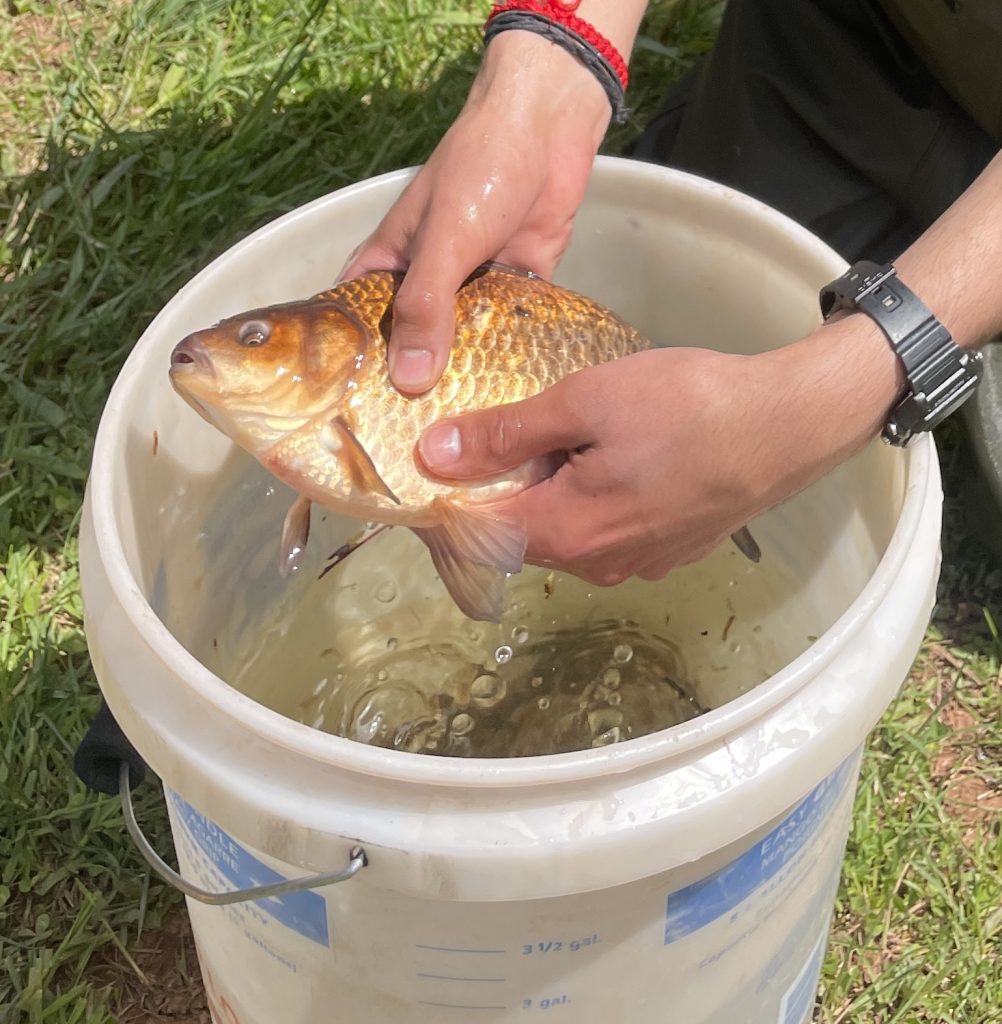
There are estimated to be over 100 different varieties of goldfish which differ in physical characteristics and color patterns. In addition, goldfish can hybridize with Asian carp, giving rise to a variety of different body forms. Below are characteristics that apply to the common goldfish:
- Elongated, rotund, and stocky body.
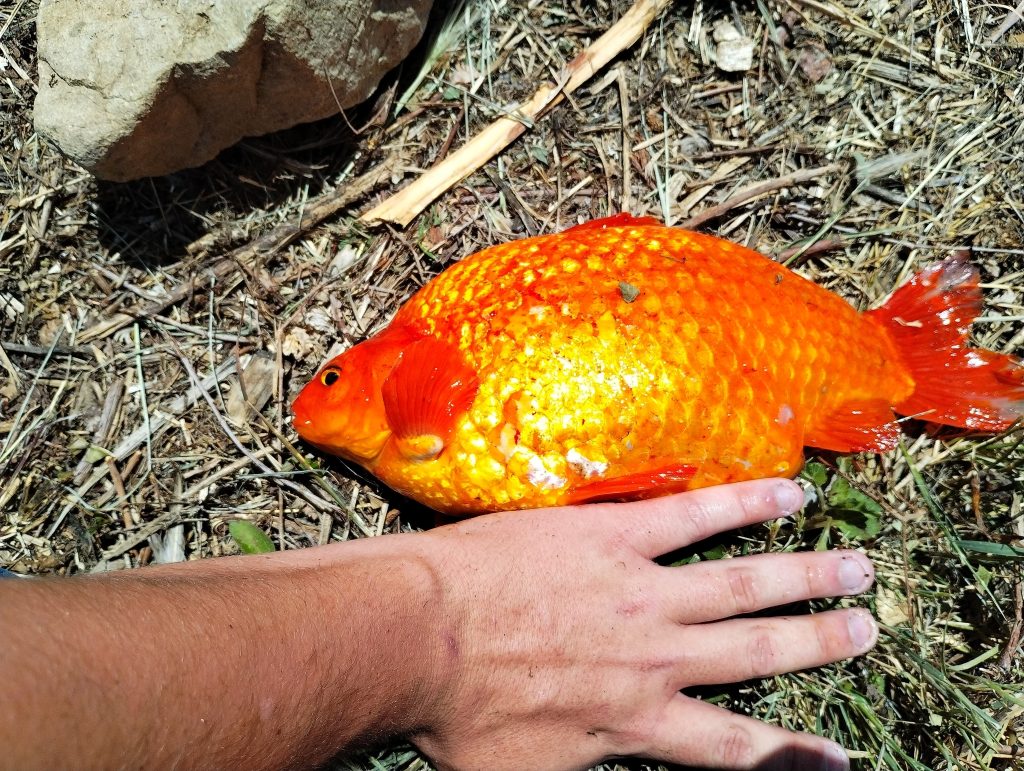
- In captivity, goldfish range between 2.5 cm – 15 cm long. In the wild, goldfish can grow much larger and typically range between 13 cm – 25.5 cm long but can reach up to 38 cm in length and weigh between 100 g – 300 g. Feral goldfish grow larger because of the richer environment and space to swim.
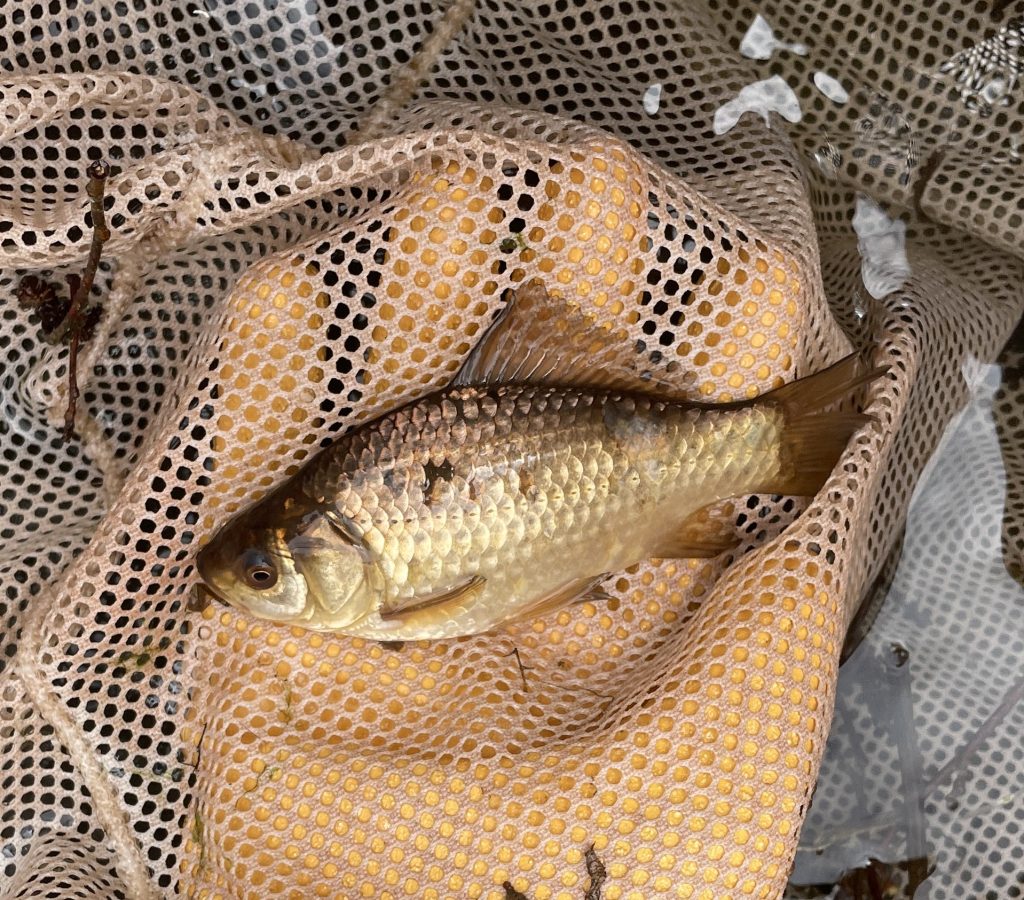
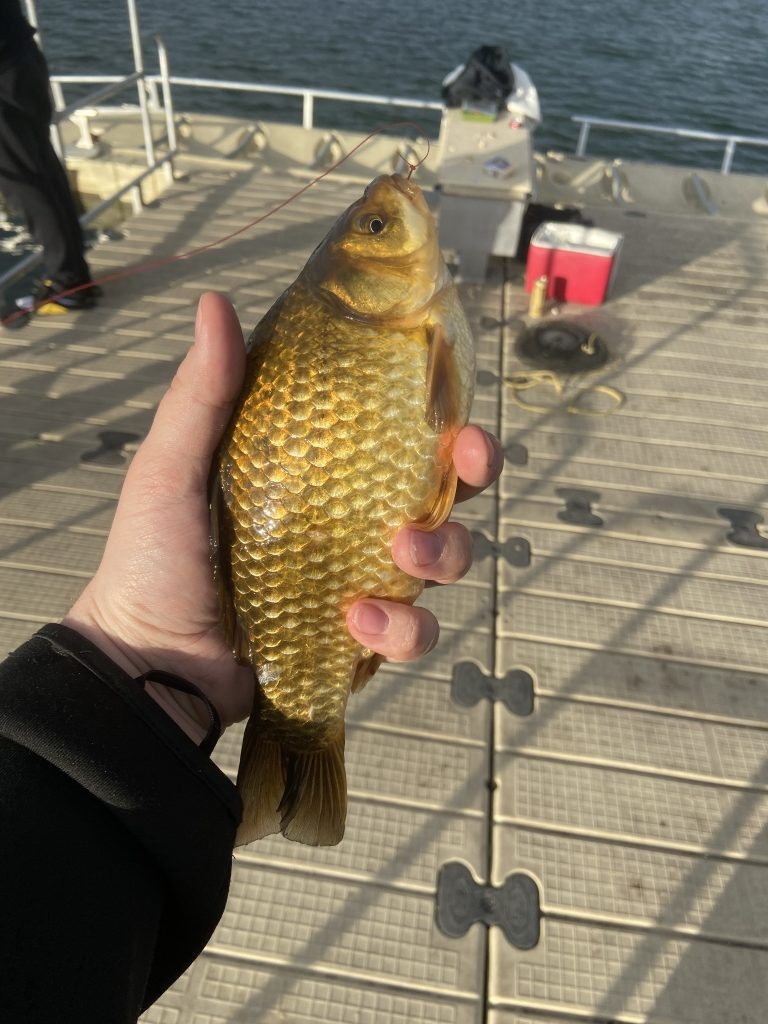
- While adults are typically bright orange, wild populations vary in colour. They can be silver, gold, brown-black or olive green in colour. Young goldfish are much darker than adults.
- Large eyes, short head that is scaleless and a small, ventral (front) facing mouth that lacks barbels. Gill rakers are long (35 – 43 rakers).
- Long dorsal fin (15 – 21 rays), concave shape, with a hard spine that is strongly serrated at the end.
- Short anal fin composed of soft rays and one hard spine at the front that is strongly serrated.
- Rounded pectoral (side) fins and deeply forked caudal (tail) fin.
Potential Lookalikes
Goldfish might be mistaken for other species in the Cyprinidae family such as:
- Common carp (Cyprinus carpio): Common carps are larger (ranging from 45 cm – 100 cm) and have a pair of barbels on each side of their mouth.
- Crucian carp (Carassius carassius): Crucian carps are laterally compressed (rather than rotund), have a blunt caudal (tail) fin, convex dorsal fin, spines in the dorsal and anal fin that are lightly serrated and shorter gill rakers (21 – 32 rakers).
- Prussian carp (Carassius gibelio): Generally, Prussian carps are silvery-brown unlike goldfish which, in the wild, are golden brown-bronze. This can be difficult to judge. As such, DNA sequencing is typically the best way to distinguish between these two species.
- Grass carp (Ctenopharyngodon Idella): Grass carp look very similar to goldfish, however, they have a much shorter dorsal fin (7 – 8 rays).
- Koi (Cyprinus rubrofuscus): Koi have a more elongated body, measure 30 cm – 120 cm long and have a pair of barbels on each side of their mouth.
Biology and Life Cycle
Biology
- Goldfish are omnivorous, however, they have a preference for phytoplankton and macrophytes. Young fish typically feed on zooplankton and insect larvae. They crush food with their pharyngeal teeth.
- Goldfish can tolerate a wide range of environmental conditions. They can survive winters in ice-covered. ponds (0°C – 10°C) and can tolerate high temperatures (up to 41°C). They can also survive in hypoxic (low oxygen), stagnant and polluted waters. They can tolerate some salinity (up to 17 parts per trillion) and pH levels between 5.5 – 10.
- Goldfish are typically found in ponds, rivers, and lakes with slow-moving water, usually living at depths between 1 m – 20 m.
Life Cycle
- In the wild, breeding typically occurs in the spring or summer when water temperatures reach 10°C. Fish become reproductively mature at 2 – 4 years old.
- Females produce eggs in their abdomen before spawning. This gives them a plumper appearance during spawning season. They can lay between 2,000 and 40,000 eggs at once.
- Male fish develop tubercles that appear as tiny dots on their operculum (gill covering) and pectoral (side) fins. They bump, nudge and chase female fish until she releases her eggs.
- Once the eggs are released, they adhere to the surfaces such as nearby plants or rocks. This prevents water currents from carrying the eggs away.
- Male fish fertilize the eggs and hatching can occur 48 hours following spawning, however, it can take up to 7 days.
- Goldfish can also reproduce asexually. Females lay eggs that do not need to be fertilized by males and hatch in identical clones of the mother. This is another mechanism by which populations can grow rapidly.
- Their typical lifespan is 5 – 15 years, however, they can survive up to 30 years. The oldest goldfish on record lived to 43 years old.
- Goldfish can hybridize with invasive Asian carps.
Pathways of Spread
Goldfish primarily spread through intentional introduction (i.e., people releasing pet fish into the environment and using them as bait fish) or unintentional introduction (i.e., escaping from outdoor ponds). Goldfish have a rich history of selective breeding in the ornamental fish trade and have been bred and raised for over 500 years. They can tolerate low oxygen and a variety of habitats which allows them to survive in the wild.
In PEI (and many Canadian provinces) it is illegal to use live or dead goldfish as bait fish.
Prevention
Once goldfish establish in an area, they become extremely difficult to control. As such, preventing their spread is crucial. Some preventative measures include:
- As the primary pathway of spread is through intentional release, it is important to never release goldfish into the environment. Instead, follow Don’t Let It Loose best practices including C.A.R.E (Contact, Act Responsibly, Report, End Ownership):
- Contact: Ask the retailer or seller if you can return the fish. You can also ask a friend to adopt your pet, or research other places that might take the fish (i.e, zoos or aquariums).
- Act Responsibly: Research pets (i.e, how large they get and how long they can live) before purchasing and ensure you can fully commit to caring for them. Ensure that outdoor water features such as ponds are contained and that there is no chance the species can escape into natural waterways.
- Report: Learn to recognize goldfish. Report any sightings to the PEI Invasive Species Council at peiinvasives@gmail.com or via direct message on Facebook or Instagram. Reports can also be made directly to the Fisheries and Oceans Canada (DFO) at: https://www.dfo-mpo.gc.ca/contact/invasive-species-especes-envahissantes-eng.html. Be sure to include photos of the fish, the location at which it was found and do not return the fish to the water.
- End ownership: As a last resort, contact a qualified veterinarian to euthanize your pet. This is the most humane option. Do not flush your fish down the toilet as this could unintentionally spread disease.
- Follow Clean, Drain, Dry best practices when moving between waterbodies to prevent the spread of invasive species.
- Clean: Remove all plants, animals, and mud from all equipment.
- Drain: Ensure that all water has been drained from the watercraft and other equipment.
- Dry: Allow adequate time for your watercraft to dry completely before moving it into another waterbody.
- Dispose: Properly dispose of unused bait. Note: In PEI (and many Canadian provinces) it is illegal to use live or dead goldfish as bait fish.
Acknowledgements
This webpage was developed with the financial support of the Department of Fisheries and Oceans Canada through the Aquatic Invasive Species Prevention Fund.
Image Gallery