EUROPEAN GREEN CRAB
Carcinus maenas
- Name and Family
- History
- Distribution
- Impacts
- Identification
- Potential Lookalikes
- Biology and Life Cycle
- Pathways of Spread
- Prevention
- Acknowledgements
- Image Gallery
Name and Family
European green crab or shore crab, Carcinus maenas, is a member of the Carcinidae family.
History
- European green crabs are native to Europe and Northern Africa. The species was first introduced to North America in 1817 via ballast water discharged by European ships . First detected along the coasts of New Jersey and New York, the species gradually spread northward, reaching the Bay of Fundy, New Brunswick in 1951 and spreading to all five Atlantic provinces by 2007. They are also found along the pacific coast in British Columbia.
- In 1997 the green crab was first identified in the southern Gulf of St. Lawrence, near Georgetown, St. Mary’s Bay, Prince Edward Island. Since then they have continued to increase in numbers and expand along the northern and southern coasts of PEI, following suitable habitat.
- Genetic evidence suggests that populations from Atlantic Canada originate from two separate introductions, and that the genetic mixing of these genotypes has facilitated its spread.
- Green crabs have been considered one of the world’s most successful aquatic invaders by the Global Invasive Species Database. They are present in almost every ocean and continental coastline in the world.
Impacts
Environmental Impacts
- Green crabs are generalist predators that feed voraciously on a variety of small shellfish and crustaceans, leading to overpredation of native species, such as clams, oysters, mussels, juvenile crabs, small fish, and lobsters.
- They are very hardy and numerous traits make them highly competitive, such as long adult lifespan (4-7 years), long larval stage, high egg production, and aggression, which allows them to outcompete native species for food and habitat.
- They threaten coastal ecosystems by destroying eelgrass and shellfish beds. Eelgrass beds provide vital habitat for many species of marine invertebrates and fish like juvenile salmon. Entire eelgrass beds can be destroyed when green crabs dig in the sediment and uproot the eelgrass, or chop the shoots at the base.
- Green crabs increase erosion of salt marshes when they mine for invertebrate prey, and can alter shoreline communities.
Economic and Social Impacts
- European green crabs pose a threat to the shellfish and fishing industries in Atlantic Canada. As a voracious predator, green crabs prey on and reduce abundance of commercially harvested species, including:
- Soft shell clam (Mya arenaria): green crabs are thought to be responsible for the collapse of the soft-shell clam industry in New England and Nova Scotia.
- American oyster (Crassostrea virginica): may impact the health of oyster beds.
- American lobster (Homarus americanus): prey on juvenile and trapped adult American lobster, and outcompete lobsters for food and shelters. Has impacted the harvest of lobster along the east coast.
- Atlantic cod (Gadus morhua): green crabs destroy eelgrass beds which are critical habitat for cod.
- Future expansion of populations could affect the sustainability of fishing communities and industries reliant on shellfish resources.
Identification
European green crabs are small coastal crustaceans that inhabit marine and brackish environments. They can be identified through the following characteristics:
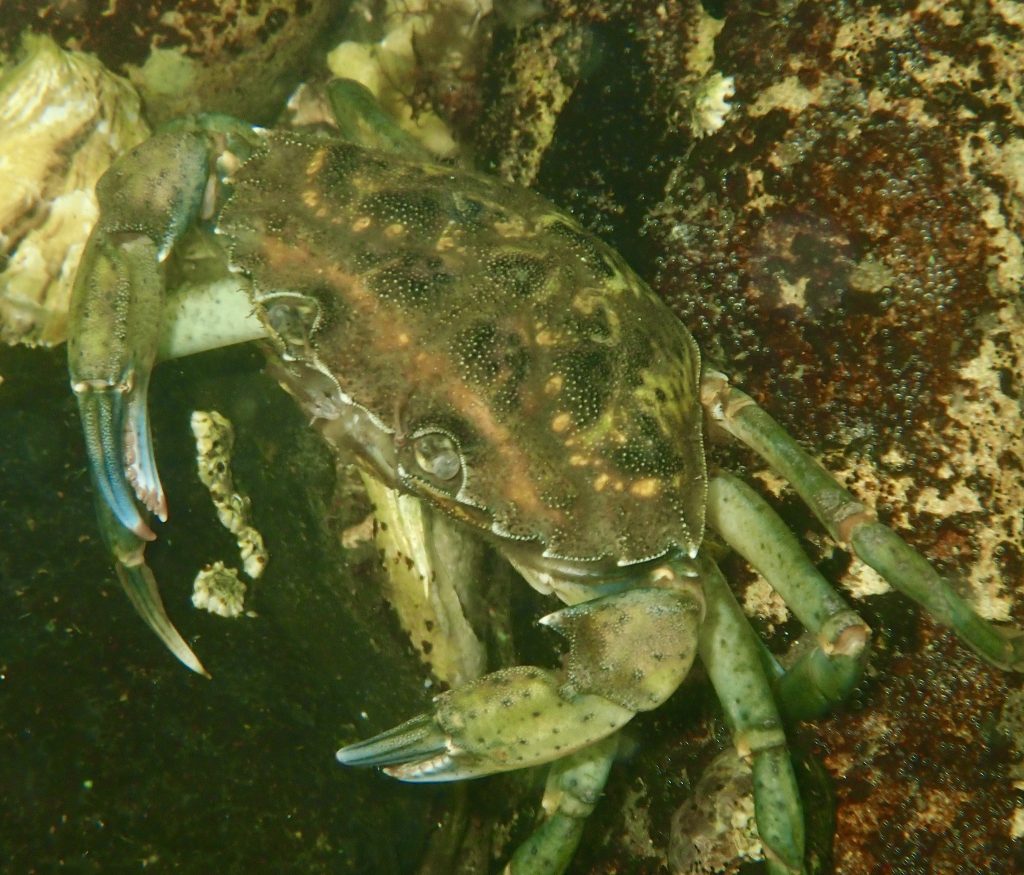
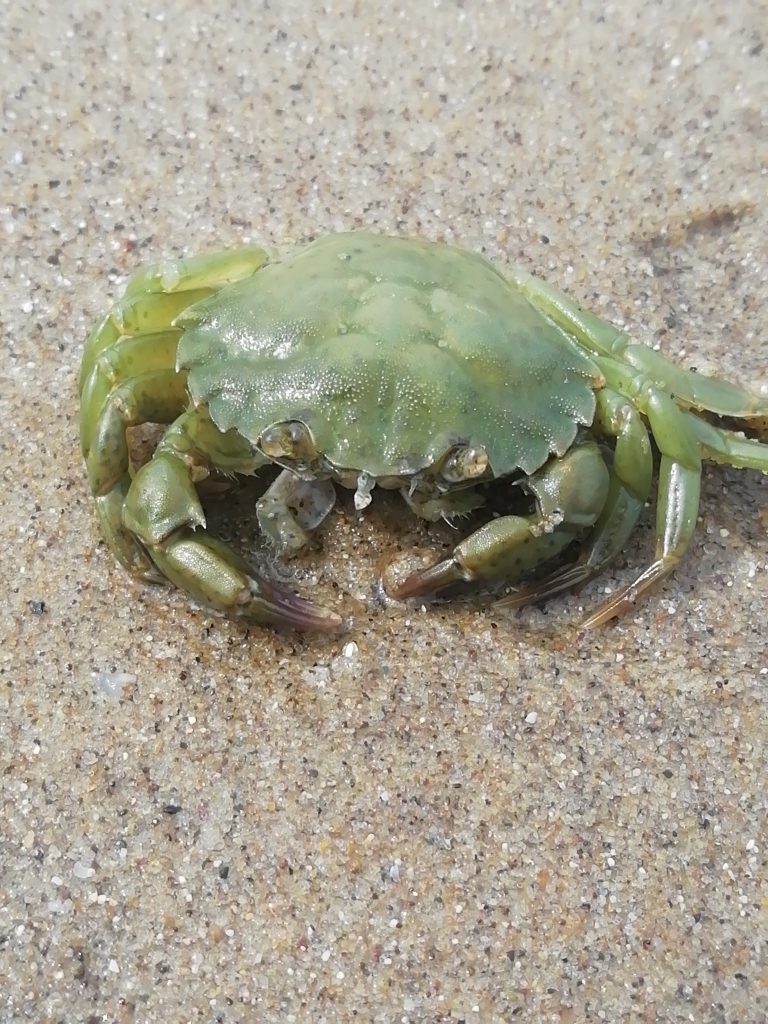
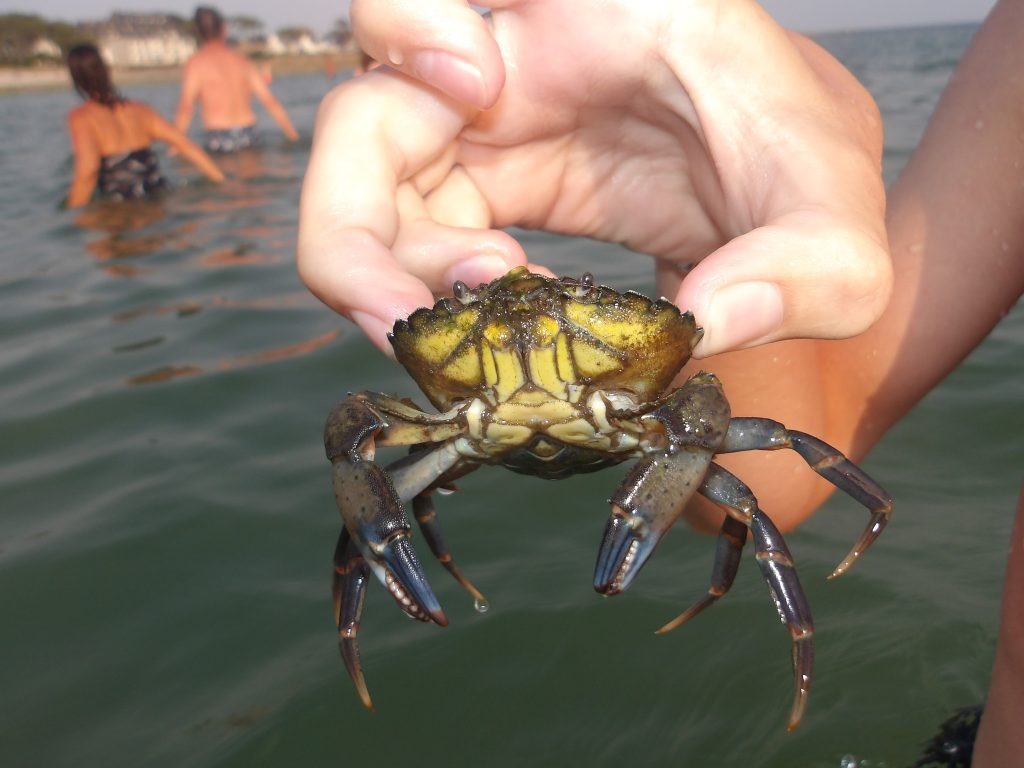
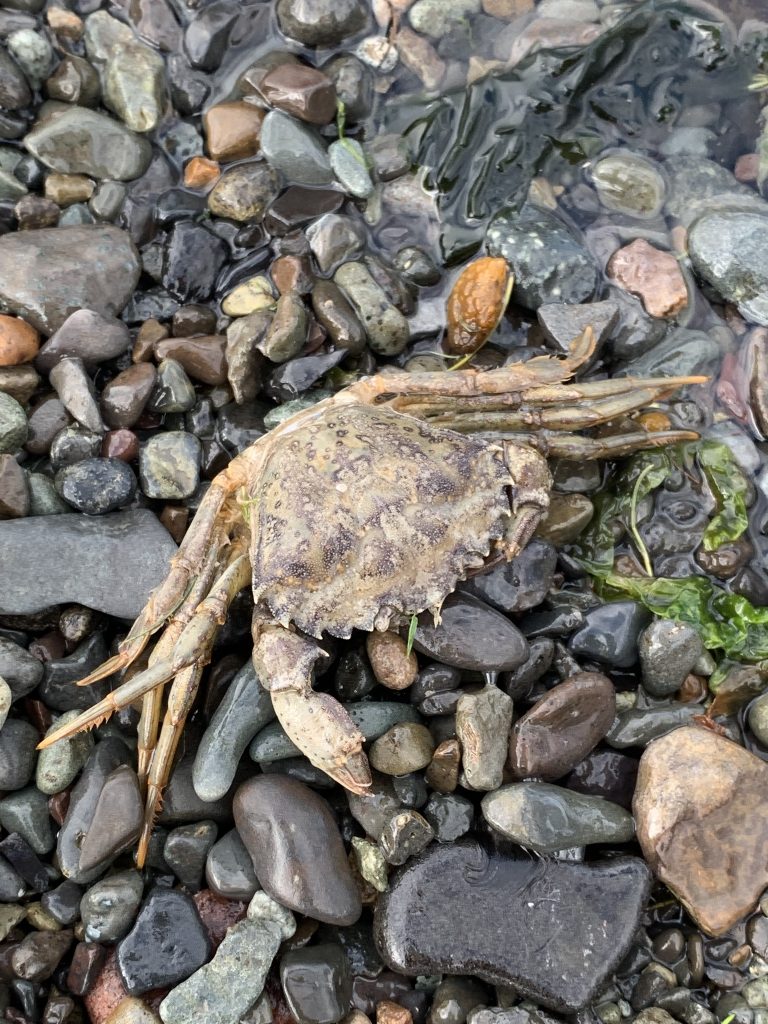
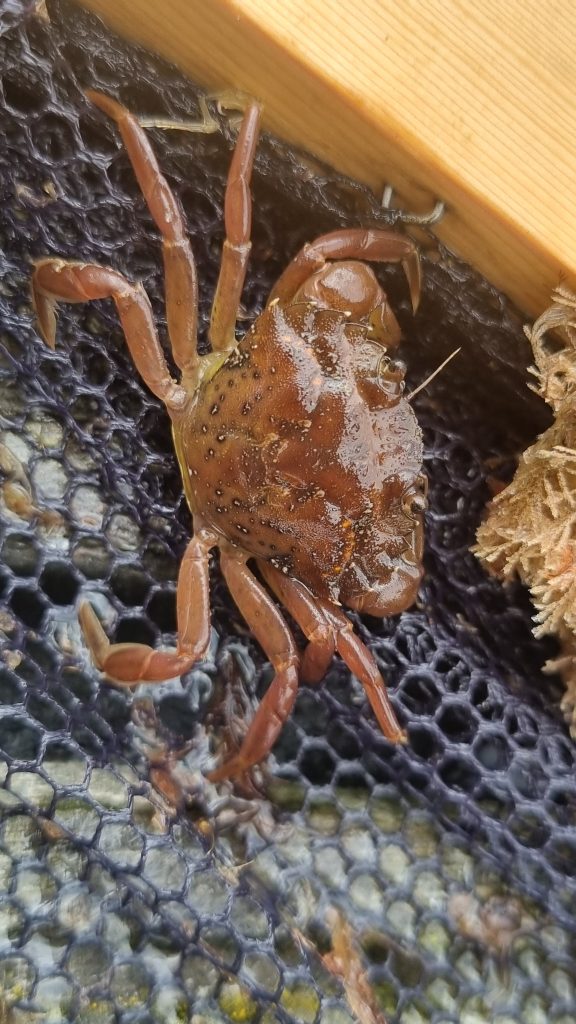
- The shell (carapace) is serrated and pentagon-shaped. It has five distinct spikes on the side of each eye and three rounded lobes between the eyes. There are two distinct crescent-shaped lines of yellow dots behind the eyes.
- The shell measures 6 – 10 cm across; males are generally larger than females of the same age.
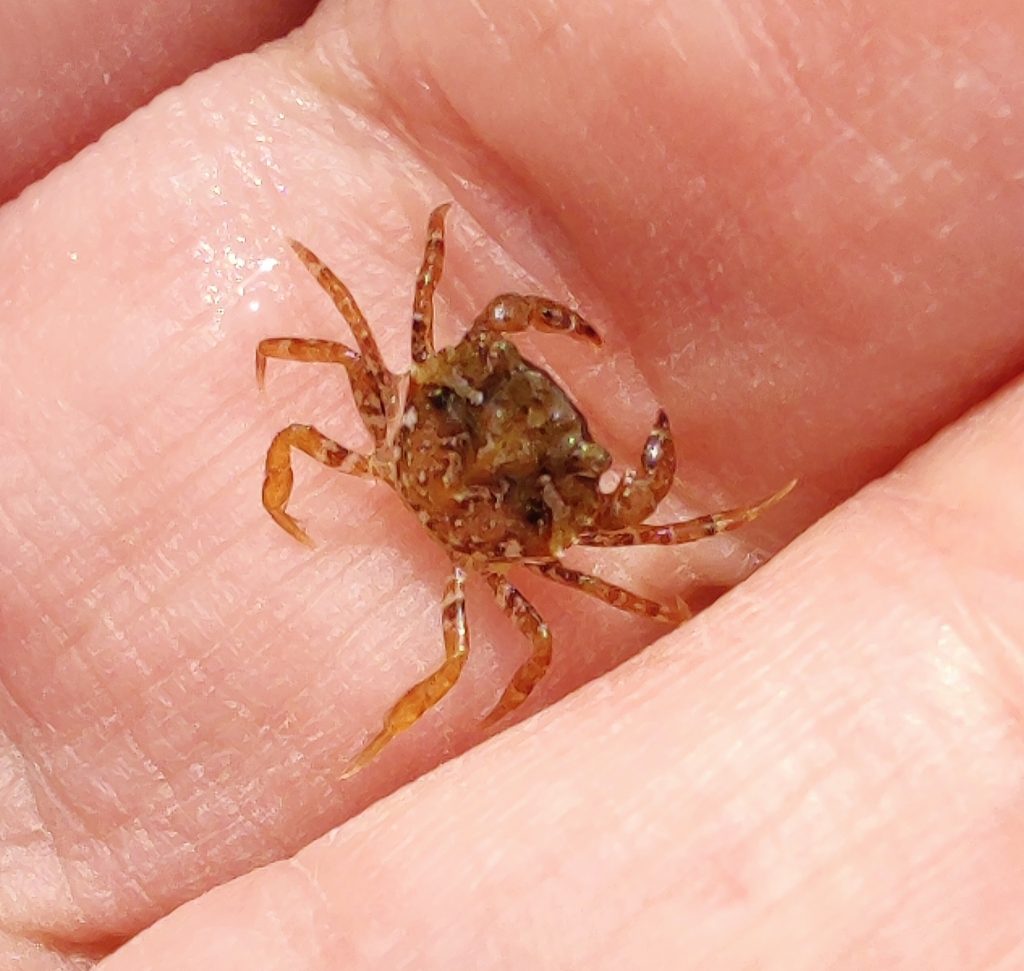
- Colour of the shell can vary widely from olive green to brown, red, orange, or yellow. Juveniles can change color to match their environment during each molt.
- The legs are long compared to its body, with narrow claws. The back leg tips are hairy, pointed, and slightly flattened. There is typically some orange colouration at the joints.
Potential Lookalikes
- There are several native green crab species in Prince Edward Island that inhabit shorelines and might be mistaken for the European green crab.
- The best way to distinguish the green crab from native crab species is by the presence of five marginal teeth on the side of each eye on the shell (carapace), and a fifth leg that is somewhat flattened and dilated, helping the crab to swim. It is also more aggressive than native crabs.
- Native crab lookalikes in PEI include:
- Rock crab (Cancer irroratus): larger (up to 15 cm), broad oval-shaped carapace that can be red/brown or purple. Has nine rounded lobes on either side of the eyes.
- Jonah crab (Cancer borealis): larger (up to 18 cm), scallop-shaped carapace, nine rounded lobes on either side of the eyes.
- Lady crab (Ovalipes ocellatus): oval tips on its hind legs, five spines on either side of the eyes (like the European green crab), is white to yellow or grey, with red or purple spots.
Biology and Life Cycle
- Green crabs can be found near the shore, in shallow waters less than 6 meters deep. They prefer sheltered areas with bottoms that are sandy, muddy, or pebbly with abundant vegetation such as eelgrass beds.
- They are able to tolerate a wide range of water temperatures and salinities, therefore can be found in a variety of environments including salt marshes, sandy beaches, pocket estuaries, and rocky coasts.
- Genetic evidence indicates two separate introductions of green crab in Atlantic Canada: one in the 1950s and a second more cold-tolerant, behaviorally distinct population from northern Europe in the 1980s–1990s. These populations have since interbred, producing a third cold-tolerant hybrid population spreading rapidly across Atlantic Canada.
- Green crabs are voracious predators that feed on a variety of prey including soft shell clams, quahogs, mussels, and oysters.
- Adults are very hardy and can survive several days on land, while the free-floating larvae can survive long periods in standing water, such as ballast water or in live wells on recreational boats.
Life Cycle
- Green crabs can live up to 4-7 years. Their life cycle alternates between benthic adults and planktonic larvae.
- Once juvenile females have molted, mating takes place. Males deposit spermatophores, containing sperm, into paired female organs (called copulatory pouches). Once fertilized, the female carries the eggs in her swimmerets for several months until they hatch. One female can spawn up to two times per year, producing up to 185,000 eggs each time.
- The eggs hatch into free-floating planktonic larvae that drift with ocean currents for up to 80 days before settling as juvenile crabs, which measure about 2 mm wide.
- The long larval phase allows green crabs to survive in standing water for long periods, such as ballast water or live wells on recreational boats, facilitating its spread.
Pathways of Spread
The European green crab’s ability to survive out of water for several days facilitates its long-distance transport through human activities. Both adult and juvenile crabs can be inadvertently moved in fishing gear, crates, buckets, recreational boats, and shipping cargo. Additionally, during their extended larval stage—lasting up to 90 days—they can spread via ballast water, live wells on boats, or by drifting with ocean currents. This larval dispersal, known as “larval drift,” is considered an important pathway for the secondary spread of green crabs after they become established in a new area.
Prevention
*Note: The European green crab is a controlled species under Federal Aquatic Invasive Species Regulations. This makes them subject to control when fishing and boating, and in areas where they are not native (which for European green crab includes all of Canada).
European green crabs are almost impossible to eradicate once established. However, it is possible to prevent further spread. Some preventative measures include:
- Clean, Drain, Dry: follow Clean, Drain, Dry best practices when moving between waterbodies to prevent the spread of invasive species.
- Clean: Remove all plants, animals, and mud from all equipment. The free-floating larvae of European green crab are very small and can be present in bilge water, live wells, or other boat compartments, while adult and juvenile crabs may hitchhike in fishing gear, crates, buckets, and other equipment. Rinse equipment with hot or pressurized water after leaving an infested waterbody.
- Drain: Ensure that all water has been drained from the watercraft and other equipment.
- Dry: Allow adequate time for your watercraft to dry completely before moving it into another waterbody.
- Report: Learn to recognize European green crabs. Take a photo, noting the exact location (GPS coordinates), the observation date, and any identifying features, and contact the PEI Invasive Species Council at peiinvasives@gmail.com or via direct message on Facebook or Instagram. Reports can also be made via iNaturalist.ca.
- Don’t Let it Loose: European green crabs can be illegally purchased online as pets. It is important to never release green crabs or any other unwanted pet into the natural environment. follow Don’t Let It Loose best practices.
Acknowledgements
This webpage was developed with the financial support of the Department of Fisheries and Oceans Canada through the Aquatic Invasive Species Prevention Fund.
Image Gallery