SMALLMOUTH BASS
Micropterus dolomieus
- Name and Family
- History
- Distribution
- Impacts
- Identification
- Potential Lookalikes
- Biology
- Life Cycle
- Pathways of Spread
- Prevention
- Acknowledgements
- Image Gallery
Introduction
Smallmouth bass are invasive freshwater fish that cause severe ecological damage. Their presence leads to the displacement and predation of native fish, as well as significant population declines in both micro and macroinvertebrate communities.
Name and Family
Smallmouth bass, Micropterus dolomieu, is a freshwater fish belonging to the Centrarchidae family, otherwise known as the sunfish family. Common names include smallmouth bass, bronzeback, brown bass.
History
Smallmouth bass are native to central and Eastern parts of North America, including the great lakes. The species is considered an invasive predatory fish in much of Atlantic Canada. Smallmouth bass was originally introduced to Nova Scotia and New Brunswick through the intentional stocking of waterbodies for the purpose of sport fishing. This practice was considered legal until the late 1990s. Since then, unauthorized introductions coupled with natural migration has led the species to expand their distribution further throughout Nova Scotia and New Brunswick. Smallmouth bass are not currently known to be present on Prince Edward Island.
Identification
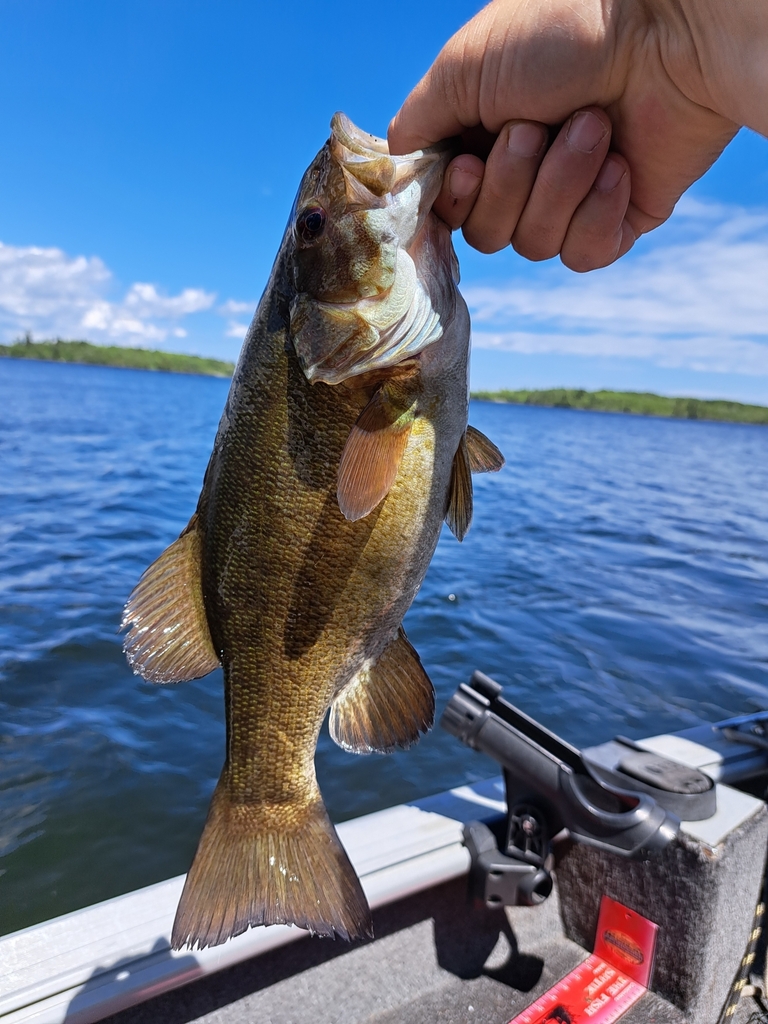
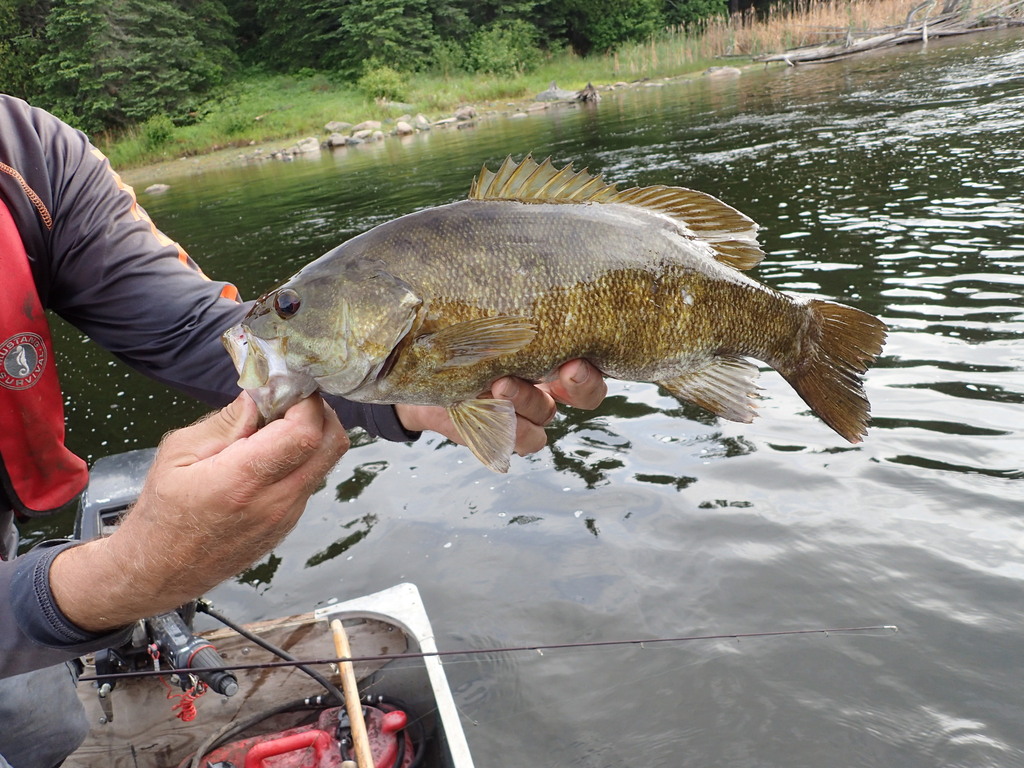
- Commonly reach 30–40 cm in length, with some individuals exceeding 50 cm
- Body is slender and oval in shape
- Joined dorsal fins (anterior fin has soft spine, while posterior
- fin is rounded and has soft rays)
- Eyes are sometimes red in colour
- Back is tan-brown to greenish gray in colour
- Sides are lighter in colour with dark vertical bars (these bars range in visibility depending on the environment)
- White underbelly
- Jaw does not extend past eye
- Slightly forked caudal fin
Potential Lookalikes
Smallmouth bass shares physical similarities with PEI’s native white perch and closely resembles the non-native largemouth bass. While largemouth bass are not currently known to occur on Prince Edward Island, they are recognized as an invasive species in Maritime Canada.
White perch is a small, silver-coloured fish with a cream-coloured underside, native to the fresh, brackish, and marine waters of Prince Edward Island. It can be distinguished from the invasive smallmouth bass using the following characteristics:
- Body Markings: Smallmouth bass feature dark vertical bands on their sides, whereas white perch lack these vertical markings.
- Facial Markings: Smallmouth bass have dark bars radiating outward from their eyes; white perch do not.
- Mouth Size: Smallmouth bass have a significantly larger mouth relative to their body size compared to white perch.
- Weight: White perch are small panfish typically weighing under 1 pound, whereas smallmouth bass can grow considerably larger (weighing up to 11 pounds).
- Dorsal Fin Shape: Both species have connected spiny and soft dorsal fins, but white perch feature a much deeper notch between the spiny and soft portions.
Largemouth bass is another predatory, invasive fish in Atlantic Canada that bears a striking resemblance to the smallmouth bass. While not currently known to be present on Prince Edward Island, any sightings should be reported immediately to the PEI Invasive Species Council.
You can distinguish largemouth bass from smallmouth bass using the following key features:
- Jaw Length: When the mouth is closed, the upper jaw of a largemouth bass extends past the back edge of the eye. A smallmouth bass’s upper jaw stops aligned with or before the eye.
- Body Markings: Largemouth bass feature a dark, continuous horizontal band running down their sides, whereas smallmouth bass feature dark vertical bars.
- Dorsal Fin Shape: A largemouth bass has a very deep notch between its spiny and soft dorsal fins, making them look almost completely separated. A smallmouth bass has a shallow notch, giving its dorsal fin a continuous, joined look.
- Coloration: Largemouth bass are typically olive-green, whereas smallmouth bass are brownish-bronze. (Note: Color can vary based on water clarity, so rely primarily on jaw and pattern markings.)
Impacts
Environmental Impacts
Smallmouth bass are very successful predators in freshwater environments.Their feeding habits often lead to the displacement and predation of juvenile Atlantic salmon. Atlantic salmon populations associated with Prince Edward Island are considered at risk and of high conservation concern.
Economic and Social Impacts
Prince Edward Island is widely recognized as having world class brook trout fishing. The angling community, as well as our Island’s tourism industry, would be greatly affected by a smallmouth bass invasion. Less individuals may travel to the island for angling opportunities if the brook trout populations dwindled due an invasion. Monitoring and management of the invasive species is also very expensive, which can put financial strain on environmental non-profits and governing bodies.
Biology
Smallmouth bass are successful predators in freshwater environments. Generally, the species will consume insects, and microcrustaceans while young, and begin hunting larger prey once they increase in size. Their voracious feeding habits directly compete with the feeding habits of native salmonids both in the juvenile stage, as well as in adulthood. As adults, smallmouth bass are known to consume other fish (including salmon fry), insects, and animals such as rodents and small birds. Their diet is known to deplete the food banks of native fish.
Smallmouth bass prefer cool waters, however, they are capable of surviving in harsher and warmer conditions. They usually frequent cool, freshwater streams with a cobbly bottom. Due to their aggressive behavior and their ability to thrive in warmer waters, Smallmouth bass often cause displacement of native fish.
Life Cycle
Smallmouth bass can live up to about 15 years in some instances, while the average life span of a Smallmouth bass is about 10 years. Adults typically reach sexual maturity between 3 to 4 years old.
Smallmouth bass spawn in shallow freshwater, in depths of around 1 metre. Adult males create a nest on rocky/cobbly bottoms where there is minimal vegetation. Once the construction of the site is complete, they begin fending off other males while actively seeking females to spawn with. Both female and male Smallmouth bass may mate with more than one other fish. During spawning, a female may release up to 21,000 eggs. The temperatures needed for the eggs to properly develop ranges between 15 and 26 degrees celcius. Generally, the eggs take between 2 and 9 days to hatch. They are guarded by the male at the nesting site until they hatch and reach around 25 mm in size.
Prevention
Smallmouth bass populations are almost impossible to remove from a waterbody once they become established. The greatest tool is prevention!
Properly dispose of unused bait in a garbage bin on land.
Never release sportfish, pets, or live bait into water bodies from which they did not originate. It is illegal, and can facilitate the introduction of harmful invasive species.
Acknowledgements
This webpage was developed with the financial support of the Department of Fisheries and Oceans Canada through the Aquatic Invasive Species Prevention Fund.
Image Gallery