Butternut Canker
Ophiognomonia clavigignenti-juglandacearum
Name and Family
Butternut canker, Ophiognomonia clavigignenti-juglandacearum, is a fungus in the Gnomoniaceae family.
History
The disease was first observed in Wisconsin in 1967, but the fungus itself remained unidentified until 1979. It is unknown where the fungus originated or how long it has existed in North America. In Canada, the disease was first reported in Québec in 1990, in Ontario in 1991, and in New Brunswick in 1998. Despite not being reported until 1990, it is thought that the disease has existed in Canada since at least 1978. Butternut canker was confirmed to be present on PEI in Charlottetown, Stratford, and St. Catherine’s in June 2025.
Butternut is thought to be non-native to PEI, but that remains unconfirmed. Butternut is widely planted on the island, especially after a Department of Agriculture planting effort in the 1970s. Despite the tree likely being non-native, it is a part of the broader Wabanaki/Acadian/Hemlock-Hardwood forest.
In July 2005, butternut was declared to be an endangered species by the Committee on the Status of Endangered Wildlife in Canada due to the impacts of butternut canker. Over 80% of the naturally occurring butternut in North America has died.
Identification Guide
Butternut, Juglans cinerea
- Butternut itself is not invasive, despite being non-native. Only the butternut canker disease, which is a separate species of fungi, is considered invasive.
- Bark – smooth on young trunks and branches, light gray in color; on older trunks deeply divided into long, broad, flat-topped, whitish ridges.
- Twigs – stout, brittle, greenish-gray in color, often hairy, easily identified by a dark-brown furry growth, or “mustache,” found just above most leaf scars; chambered pith dark brown as contrasted with the light brown chambered pith of the black walnut.
- Winter buds – terminal bud pale, downy, blunt-pointed 1/2 to 3/4 inch long, flattened, longer than wide; lateral buds smaller and shorter.
- Leaves – alternate, compound, with 11 to 17 practically stemless long-pointed leaflets, margins serrated as in black walnut; leaves up to 2 1/2 feet in length; leaf stalk, hairy where it joins stem.
- Fruit – a rather large nut, 1 1/2 inches long, tapering at the end, black with fine cut ridges, enclosed in a sticky, green husk usually in clusters of 3 to 5, ripening in October of the first season. Kernel – sweet, oily, but somewhat difficult to extract.
- Distinguishing features: “mustache” above “monkey-faced” leaf scars; dark brown, chambered pith.
- Above identification information sourced from Cornell University: http://bhort.bh.cornell.edu/tree/butternut.htm, Copyright © 2000-2004, L. H. Bailey Hortorium, Cornell University, Ithaca, NY 14853, (607) 256-5341
- Lookalikes:
- Ash
- White ash, Fraxinus americana
- Black ash, Fraxinus nigra
- Green ash, Fraxinus pennslyvanica
- European ash, Fraxinus excelsior
- Mountain ash
- American mountain ash, Sorbus americana
- European mountain ash, Sorbus aucuparia
- Showy mountain ash, Sorbus decora
- Staghorn sumac, Rhus typhina
- Elder
- Common elder, Sambucus canadensis
- Red-berried elder, Sambucus racemosa
- Black walnut, Juglans nigra
- Tree-of-heaven, Ailanthus altissima
- Ash
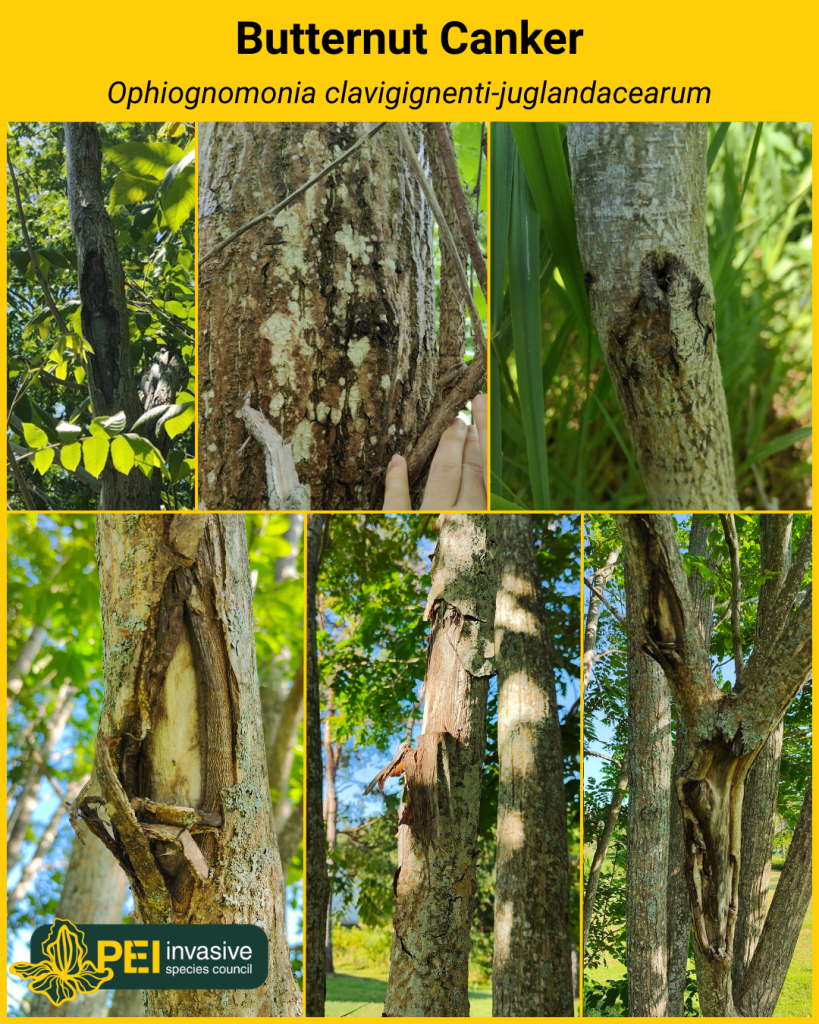
Butternut canker
- Other tree species may display cankers, but no other known canker diseases of butternut trees have been found on PEI. These may, however, exist undetected. This means that if the butternut tree has cankers, it is almost certainly affected by butternut canker.
- Signs and symptoms of butternut canker:
- The most obvious symptoms are elongated, sunken cankers that appear on the trunk or branches.
- Cankers exude a black substance in spring.
- In summer, cankers appear as black sooty patches, often with whitish edges.
- Dark brown or black patches in the cambium beneath the outer bark.
- Disease usually begins at the top of the tree and moves downward.
- Older cankers may be covered with scar tissue and shredded bark as the tree attempts to heal itself.
- Young cankers may appear as cracks in the bark around a small area, often with blackened edges and streaks.
- Damaged bark and pruned branches may confuse identification.
Impacts
- Affects only butternut trees.
- Butternut canker has killed up to 80% of the naturally occurring butternut populations found in Ontario and the United States, and in some areas as high as 90% of butternut trees have been lost. At such a rate, this disease may lead to the functional extinction of butternut on the landscape. Functional extinction means that all wild populations have been killed or affected, ceasing its ecological function, and the species only exists in small pockets or under cultivation. Butternut canker’s impacts have singlehandedly caused the designation of butternut as endangered by the Committee on the Status of Endangered Wildlife in Canada (COSEWIC).
- Butternut provides food and shelter to many species that would be affected by the loss of butternut.
- Butternut nuts are edible to humans (they’re delicious!), and losing them would remove a source of nutrients. Consume butternut at your own risk. Ensure that you have a clear ID of the plant before making decisions about consuming it.
- No truly resistant butternut trees have been identified to date. Tolerance to the disease is highly variable based on the individual’s health, site conditions, and potentially also some unknown genetic factors.
Management
As of November 2025, there are no available chemical or biological control methods to address butternut canker-affected trees. Since butternut is an endangered species, its removal may be limited based on the PEI Wildlife Conservation Act’s regulations. On federal land, a permit is needed before action is taken to disturb butternut trees. This activity is regulated by federal regulations in the Species at Risk Act.
Despite the fact that no known effective chemical or biological control measures for butternut canker are yet available, improving the health of remaining trees that show the highest degree of resistance through good silvicultural practice is recommended. Taking such measures will improve the health and survival of the remaining trees. For more information on good silvicultural practice, contact an arborist, silviculturalist, or forestry professional.
Before taking any actions to control a suspected butternut canker infestation, it is important to report your findings to the PEIISC so the disease’s identity can be confirmed.
After assessment, affected trees should either be removed or maintained on the landscape at the property owner’s discretion. The PEIISC generally recommends the removal of severely impacted trees followed by the burial or incineration of removed butternut material to reduce the amount of butternut canker present on the landscape and reduce the chances of further spread.
If you plan to maintain infected butternut on the landscape, pruning out infected branches and removing cankers can help reduce the amount of butternut canker inoculum on the landscape and potentially extend the tree’s lifespan if done correctly. Pruning should be undertaken from October to March. Pruning trees from March to October may attract insect pests, further stressing the tree.
The information below is from the Canadian Forest Service:
Scientists have identified strategies to promote the survival of butternut trees.
- Keep at least 10 butternut trees per hectare by creating stand openings that equal twice the height of the surrounding trees to encourage seed germination and seedling growth.
- Keep all butternut trees without cankers that have 50% or more living crown.
- Keep all butternut trees with less than 20% of the trunk’s circumference affected by the fungus and more than 30% of the crown alive.
- Butternut trees growing above the forest canopy and in open fields are preferred.
In a forest stand or managed woodlot, infected trees should be removed as quickly as possible to limit the spread of the disease.
- Remove any tree with at least 30% of its crown leafless and at least 20% of the trunk’s circumference affected by the fungus.
- Remove any tree with more than 50% of its crown damaged even if the trunk is canker-free.
- High-value trees that are severely infected can be conserved by pruning the affected branches and cutting off trunk cankers.
In nurseries, destroy young trees that carry the disease. Do not grow seedlings from contaminated nuts (CCDMD 2009).
Interventions are aimed at protecting healthy trees. Infected trees in forest stands or managed woodlots must be cut down as quickly as possible to salvage the merchantable wood. Dying and dead trees should be felled and the wood disposed of to promote regeneration and reduce the inoculum load. In butternut stands, all trees that have at least 30% crown dieback and cankers covering at least 20% of the circumference of their main stem should be removed, as should trees with more than 50% crown dieback even if they have no trunk damage (Ostry et al. 1994, 1996; Davis & Meyer 2004; DesRochers & Lupien 2008).The gap-selection method can be used to promote butternut regeneration provided that the diameter of the gap that is created is equal to or twice the height of butternut. This should be implemented on optimal sites for butternut, such as rich fertile lowland areas and south-facing terraces bordering the St. Lawrence in southern Quebec (DesRochers & Lupien 2008). Control of competing vegetation will allow young butternut to become established in these openings (Ostry et al 1994).
Ornamental trees with minor symptoms can be pruned and cankers can be excised from their trunk provided they are small and few in number (DesRochers & Lupien 2008). It is important to disinfect pruning and tree surgery tools between cuts (BNQ 2001; Thibault 1993).According to SARA, is is mandatory to obtain a permit from the adequate authorities (Environment Canada and Parks Canada) before any mechanical treatment is achieved on butternut on federal lands. Butternut canker
— END CFS INFORMATION —
Disposal and site exit
- If you have been in an area with butternut canker, it is a good idea to wash your clothing thoroughly before entering an area with healthy/unaffected butternut.
- Tools should be disinfected before leaving the site or being used on other trees.
- Using a bleach bath for boots may reduce the chance of spreading spores on footwear.
Remediation and restoration
- Trees with similar appearance and function can be reintroduced into the area after butternut is lost.
- Choose the right tree for the area, taking into consideration things like level of sunlight, moisture, soil depth, soil type, ornamental value, and function.
- If you have planted your butternut for ornamental purposes, here are some comparable alternatives:
- White ash, Fraxinus americana
- Black walnut, Juglans nigra
- American mountain ash, Sorbus americana
Reporting
It is important to report invasive species you see on the landscape to the PEIISC. This allows us to better assess the status of invasive species and plan future action. There are a variety of ways to deliver the information, see below for the list. We are especially interested in reports of butternut canker found outside of Charlottetown, Stratford, and St. Catherine’s.
Reporting methods:
- Email: peiinvasives@gmail.com
- Facebook: www.facebook.com/PEIInvasives
- Instagram: www.instagram.com/peiinvasives
- www.iNaturalist.ca or the iNaturalist app on Android or iPhone.
What to include in your report
- Your contact information.
- Where you found it.
- When you found it.
- Photos of the tree and close-ups of any damage that may be present, especially cankers.
Image Gallery
References
Butternut canker – Natural Resources Canada
Butternut Forest Gene Conservation Association Brochure
Butternut Landowner’s Guide, Ontario
Conservation and Management of Butternut Trees, Purdue University